
The Battle for Customer Context: Where the Next Software Moats Will Be Built
All views expressed are my own and do not necessarily reflect those of my employer.

· 9 min read

Brian Halligan is back, and HubSpot is now the "Customer Harness Company."
The trend these days is to say, "I didn't have that on my 2026 bingo card." But is this announcement really all that surprising?
Enterprise SaaS is in the middle of an identity crisis.
For decades, we've watched the industry cycle between bundling and unbundling software. Best-of-breed point solutions were all the rage, until they weren't. Platforms became the economical, seemingly inevitable answer to runaway enterprise software spend.
That worked until those same platform vendors locked customers into their ecosystems, effectively holding them hostage. Enter the composable era, where flexibility, interoperability, and freedom of choice became the new selling points.
And that's the era we're still in. Kinda. Sorta.
Composability and headless architectures laid the groundwork for the MCP era, but they still skirt the fundamental issue: who controls the customer context, and who gets to act on it?
We're moving beyond the decades-old debate of bundling versus unbundling. Enterprises increasingly want ownership of their data, freedom to choose the intelligence that operates on it, and the ability to execute across systems without being beholden to any single vendor.
Most customers aren't explicitly asking for this architecture, but their demands are pushing the industry in that direction.
And traditional enterprise software vendors are struggling to reconcile that reality with business models built around owning the application, the workflow, and the customer relationship.
This is where the concept of a "harness" gets interesting.
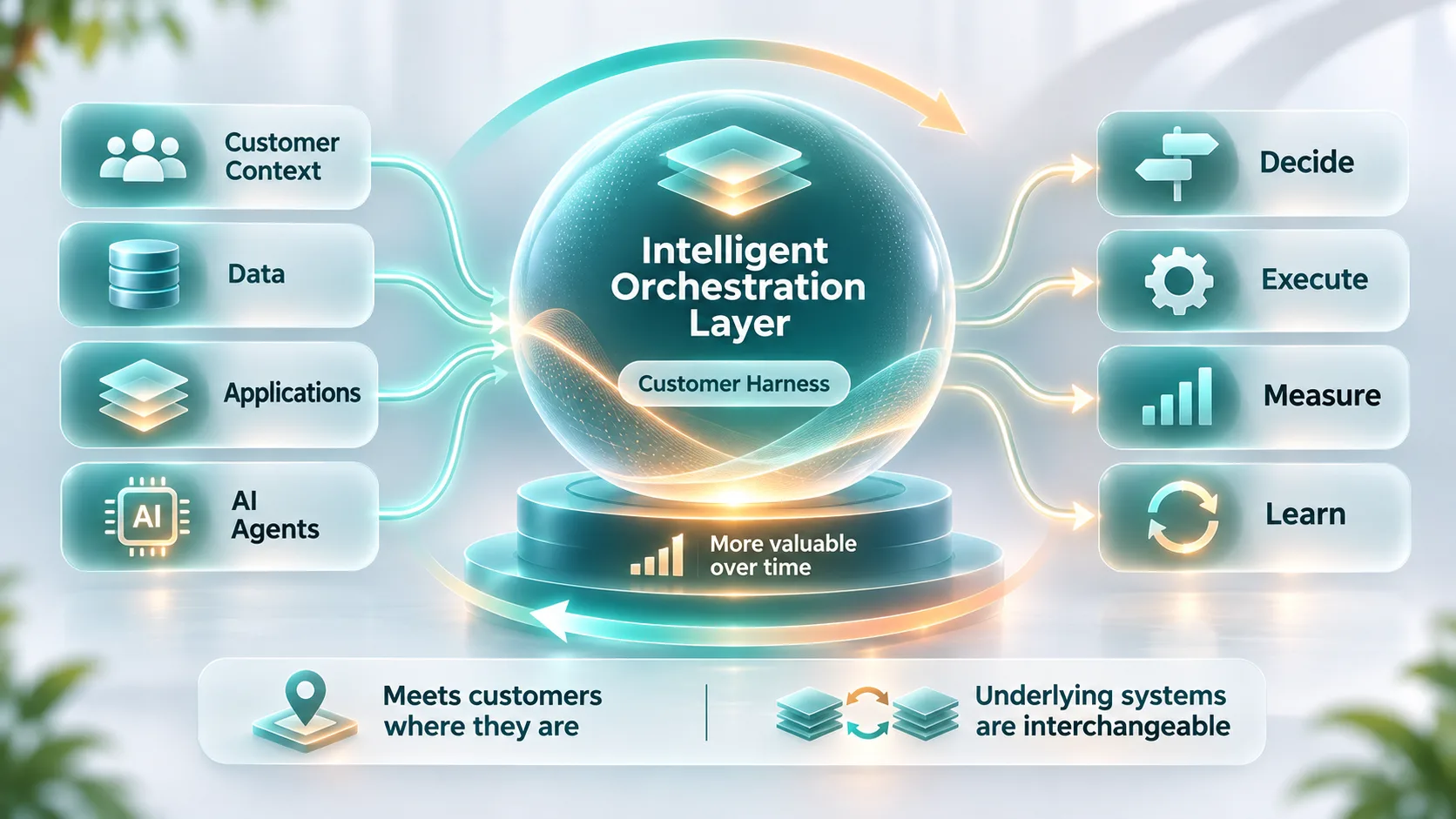
The promise of a harness isn't another platform that tries to do everything. It's an intelligent orchestration layer that connects customer context, data, applications, and AI agents to execute outcomes across the enterprise. Rather than forcing customers to consolidate their data and workflows into a single ecosystem, the harness meets them where they are, bringing together the right context, intelligence, and tools to get work done. In theory, the underlying systems become interchangeable, while the intelligence that connects them becomes increasingly valuable.
But does HubSpot have the right to claim the "customer harness" mantle? I'm not convinced.
Much like Salesforce, HubSpot may need to buy its way into that position. To get there, it will need to build a far more robust and open API ecosystem across its cloud, essentially the 2026 version of unbundling. And it certainly seems prepared to do so.
But here's where I think HubSpot is exposed. To become the "customer brain" that powers orchestration and decisioning across the next generation of agentic software, its vision still largely depends on customers adopting HubSpot as their CRM. That feels increasingly at odds with where the market is heading.
Enterprises are moving toward greater control over their data, context, and intelligence, not deeper dependency on a single vendor's ecosystem. Salesforce is facing a similar challenge, and I'd argue its recent acquisition spree reflects just how aggressively these incumbents are trying to reposition themselves for what's next.
Watching the 2026 M&A landscape take shape, I’ve found myself increasingly focused on a question that I think will define the next several years of enterprise software: what will actually make a platform irreplaceable?
Salesforce's announced acquisition of Braze has me thinking about a much more interesting question: What does Braze possess that Salesforce, despite years of investment in Marketing Cloud, believes is worth billions to acquire rather than build?
My hypothesis is that the answer goes well beyond feature gaps. Braze has built a real-time, event-driven engagement architecture that continuously processes customer behavior, updates context, and orchestrates decisions across channels at enormous scale.
Salesforce could continue investing in these capabilities organically. But its decision to acquire Braze suggests that replicating the architecture, expertise, and market maturity behind those capabilities may be far more difficult—or time-consuming—than replicating the features themselves.
And that raises the bigger question I've been wrestling with: What if the most durable moat in enterprise software isn't the functionality a platform delivers today, but its ability to continuously develop better context, make better decisions, and learn from the outcomes?
For years, we’ve made sense of an expanding technology universe by organizing vendors around jobs to be done. The LUMA landscape and Scott Brinker’s Marketing Technology Landscape helped visualize the sprawl. Gartner’s Magic Quadrants helped buyers debate which vendors led within established categories. Those approaches were useful. They gave us a way to navigate complexity.
Then AI accelerated, and our language changed. We started debating wrappers, layers, and harnesses - which applications are genuinely differentiated, which are simply packaging a foundation model, and which provide the data, orchestration, permissions, and guardrails agents need to operate. I don’t see that evolution as empty terminology. I see us getting closer to a more consequential question: where can durable value actually compound?
Category names will change faster than the learning loops that actually create value.
The next winners may not simply execute the jobs we prescribe. They may become so context-aware that they identify which jobs need to be done, determine when intervention is worthwhile, take appropriate action, and learn from what happens next.
From feature categories to compounding context
Consider a basic lifecycle marketing scenario: a customer is a 42-year-old, first-time purchaser in Massachusetts. Today, a marketer might place that person into a post-purchase journey, apply a few rules, and schedule an offer. In a more intelligent system, that initial profile is just the start of an evolving hypothesis.
Agents could continually compare that individual’s behavior with relevant cohorts, recent purchases, browsing patterns, timing, product affinities, pricing responses, and observed outcomes. Some context would be known; other elements would be probabilistic or inferred, with uncertainty made explicit. The system could estimate whether an offer, education sequence, different channel, or no intervention at all is most likely to create incremental value.
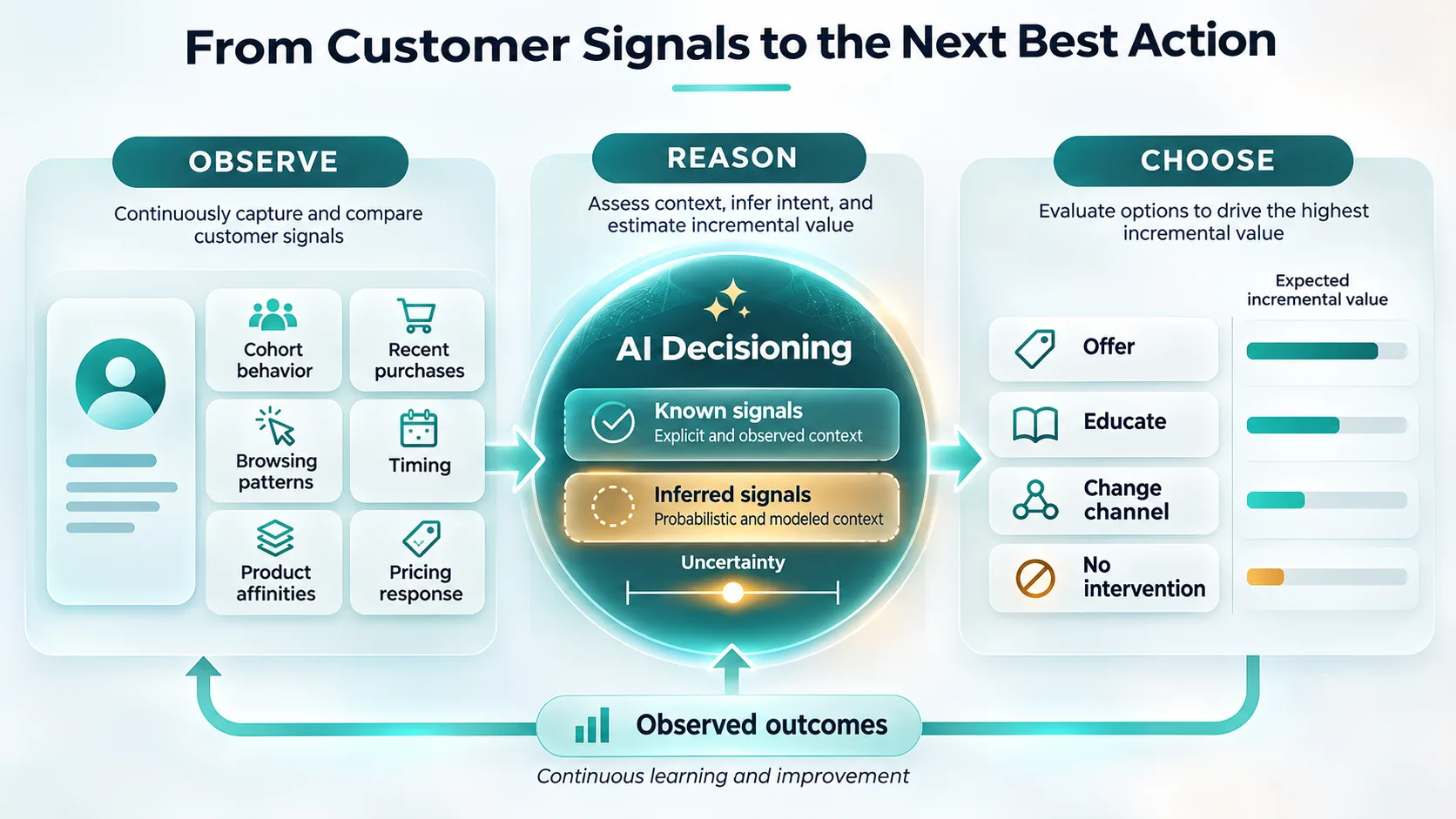
What matters is what follows. Did the customer purchase again? Ignore the message? Buy without the incentive? Return a product? Become more engaged six weeks later? The system needs to connect those outcomes back to its earlier decisions. Ideally, it tests alternatives so it can distinguish correlation from actual lift.
That is more than a customer profile. It is a continuously updated understanding of the customer, and of which actions are worth taking.
A network of micro-loops — not one all-knowing agent
I expect this intelligence to emerge through many narrow, coordinated loops. One agent might investigate why one-time buyers are not converting again. Another might measure regional price sensitivity. Another could detect that silence after a campaign signals fatigue in one cohort but healthy purchase intent in another. Others might assess product usage, competitor movement, seasonality, account expansion, or channel saturation.
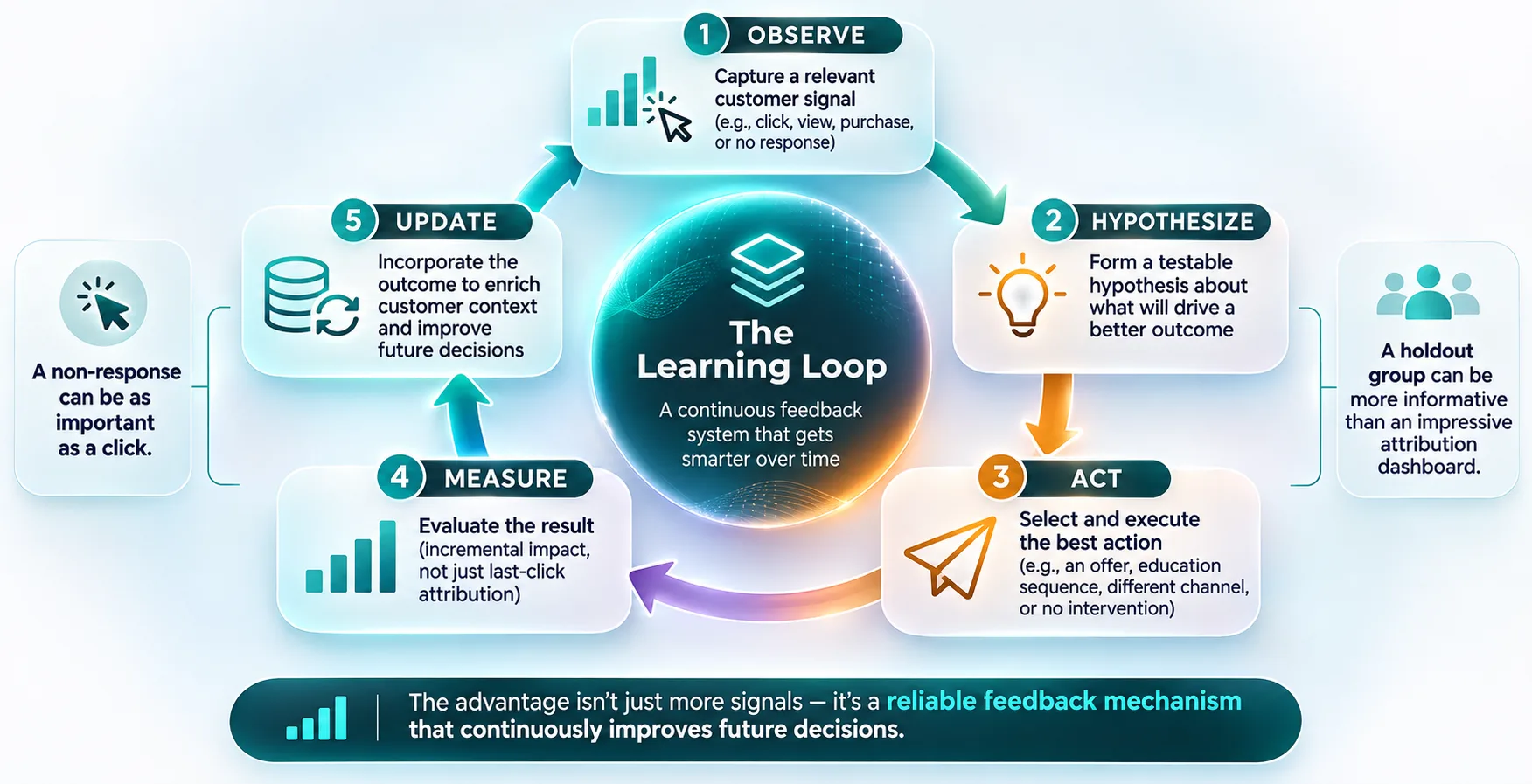
Each loop follows a similar discipline: observe a signal, form a hypothesis, select an action, measure the result, and update the context available to the rest of the system. A non-response can matter as much as a click. A holdout group may be more informative than an impressive attribution dashboard. The advantage is not merely collecting additional signals, but building a reliable feedback mechanism that improves future decisions.
Calling every feedback process “reinforcement learning” would be too loose. Some loops will use experimentation, causal measurement, forecasting, Bayesian updates, or conventional machine-learning models. Others may eventually use reinforcement learning where the environment and reward signals support it. The common thread is measurable learning, not a fashionable label.
The boundaries between categories start to blur
This is where the implications get more interesting. The same machinery that recognizes a change in customer purchase intent can recognize a former champion taking a role at a new company, a funding event in a target account, a change in competitive technology, or an emerging pattern across a territory.
Historically, we would place those capabilities into different vendor categories. A sales intelligence platform monitors account signals; a CRM stores relationships; a marketing automation platform executes campaigns; an engagement platform orchestrates lifecycle experiences. But why must the intelligence itself respect those boundaries?
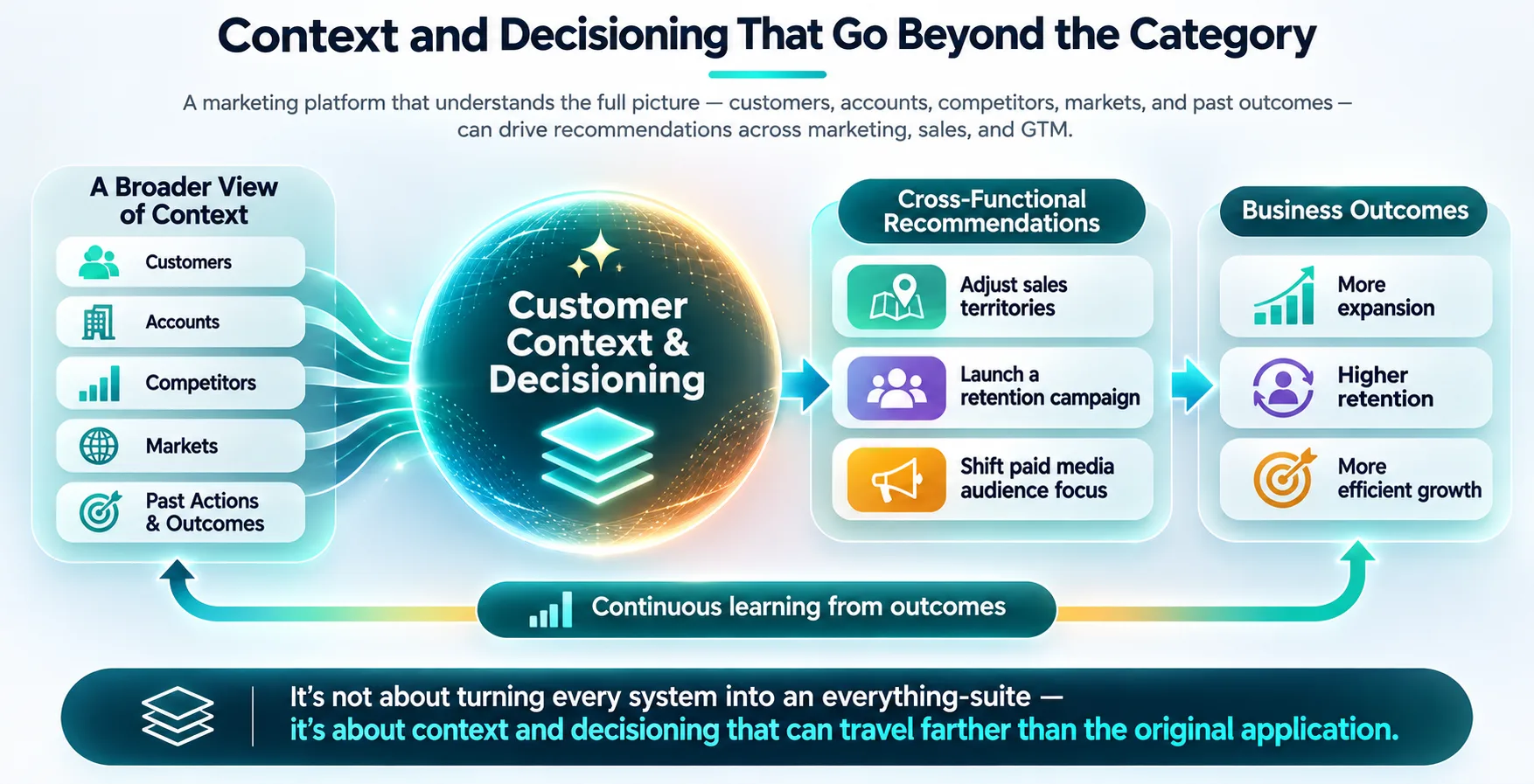
If a marketing platform understands customers, accounts, competitors, markets, and the outcomes of prior actions, it could eventually recommend a territory adjustment as naturally as it recommends a retention campaign. A signal that begins in marketing may reveal a sales expansion opportunity. An account signal may change which audience deserves attention in paid media. That doesn’t mean every system should become an everything-suite. It means the context and decisioning capabilities may travel farther than the original application category.
The battle is not simply over who stores the data. It is over who builds and refines the most actionable understanding of an evolving environment — and who is trusted to act on it.
The race to own the context layer
Different companies enter that race from different starting positions. Snowflake and Databricks sit close to the governed enterprise data foundation. Salesforce has rich CRM, commercial, and workflow context. Customer engagement platforms such as Iterable and Customer.io sit close to customer interactions and their outcomes. Hightouch is approaching the challenge from warehouse-native activation and agentic marketing workflows.
The strategic direction is increasingly visible in public product announcements. Databricks introduced CustomerLake in June 2026 and advanced its campaign agents to beta in October, bringing identity, segmentation, activation, and agents into its lakehouse environment. Hightouch has explicitly described its ambition to assemble a marketing context layer, build proactive agents, execute across channels, and feed learnings back into that context. Scott Brinker has written about the migration of MarTech from applications toward infrastructure and the collision of previously separate platform categories.
Those are not identical architectures, and a vendor roadmap is not proof of a defensible moat. But the common objective is unmistakable: reduce the distance between knowing, deciding, acting, and learning.
Will the foundational platforms swallow the applications?
It would be a mistake to dismiss the foundations. Databricks CustomerLake is a concrete reminder that a data platform can move beyond storage and analytics into marketer-facing execution. Snowflake is also advocating an open ecosystem built around governed context and AI. Over the next two to three years, capabilities once associated with stand-alone SaaS products may increasingly be offered much closer to the enterprise data layer.
Still, technical possibility is not the same as organizational adoption. Some enterprises have centralized engineering and AI centers of excellence that can operationalize workflows directly on their data platform. Others rely on marketing, sales, service, and revenue teams to own specialized tools, budgets, experimentation cadence, and day-to-day execution. They may value speed, business-user autonomy, domain expertise, and a clear operating model more than architectural purity.
My expectation is not a single winner-take-all stack. It is a market with real optionality: infrastructure-native execution for some use cases, specialized applications for others, and bridges that let context move between the two. Governance, permissions, identity resolution, interoperability, and feedback will determine how well those options work in practice.
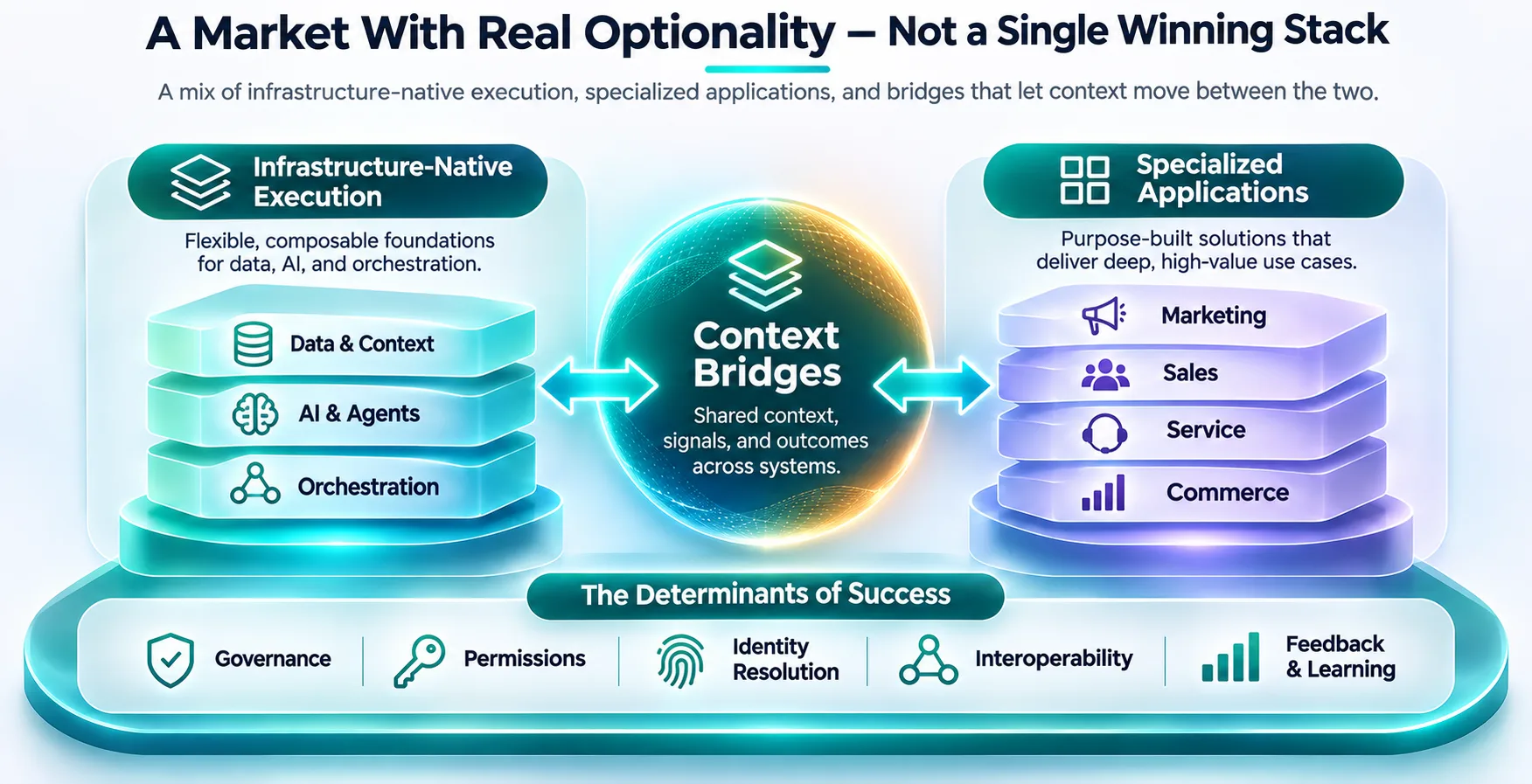
That raises the hardest question for providers in the middle: if the models become smarter and cheaper, and data access becomes more portable, does your product become more valuable — or simply less differentiated? A polished interface and access to an LLM are not enough. The defensibility has to survive improvements in the model beneath it.
What consolidation is really buying
Historically, many MarTech acquisitions could be explained through product adjacency, geographic coverage, cross-sell, or a larger installed base. Those rationales still matter. AI adds another test: does an acquisition complete a missing part of the learning loop?
The announced Salesforce–Braze deal is worth watching through that lens. Salesforce describes a combination of real-time engagement and decisioning with CRM, Data 360, and Agentforce. Whether integration delivers that promise remains to be seen, but the strategic premise is revealing. Acquiring execution without feedback, data without decisioning, or agents without reliable context may be less valuable than combining capabilities that continually make one another more effective.
I would evaluate consolidation through four questions. Does it expand the quality and freshness of context? Does it improve the system’s ability to identify the next worthwhile action? Does it connect that decision to reliable execution? And, critically, does it return measured outcomes so future decisions improve? Acquisitions that close those gaps could be more strategic than acquisitions that merely add another feature.
The measure of a durable moat
I don’t think the next winners will be defined by which quadrant they lead or how many agents they deploy. They’ll be defined by how reliably they turn data into intelligence that gets better with every outcome.
As micro-loops multiply and boundaries blur, I’ll be watching consolidation for one signal: who is assembling the missing pieces of compounding intelligence?
Ultimately, the most important test might be simple. If your customers use your platform for another three years, what will your technology understand that a competitor can’t easily replicate?
About the author
Chris Parker is a sales and revenue executive with over 15 years of experience building and scaling high-performing teams across marketing technology, customer engagement, and data platforms. Currently VP of Global Client Sales at Iterable, Chris has a proven track record of driving revenue growth, developing talent, and building successful go-to-market strategies. He is passionate about leadership, emerging technology, and the evolving role of AI in transforming customer engagement.
Related Insights

The Future of MarTech & SaaS
Why Early-Stage DTC Brands Miss the Mark on Retention
Acquiring a new customer costs 5x more than keeping an old one. And yet, most early-stage brands are so blinded by the dopamine rush of new customer notifications that they miss the real goldmine: retention. Let’s be real. Most early-stage brands aren’t ignoring retention because they don’t care. They’re ignoring it because they don’t know where to start.
November 7, 2026 · 3 min read
The Future of MarTech & SaaS
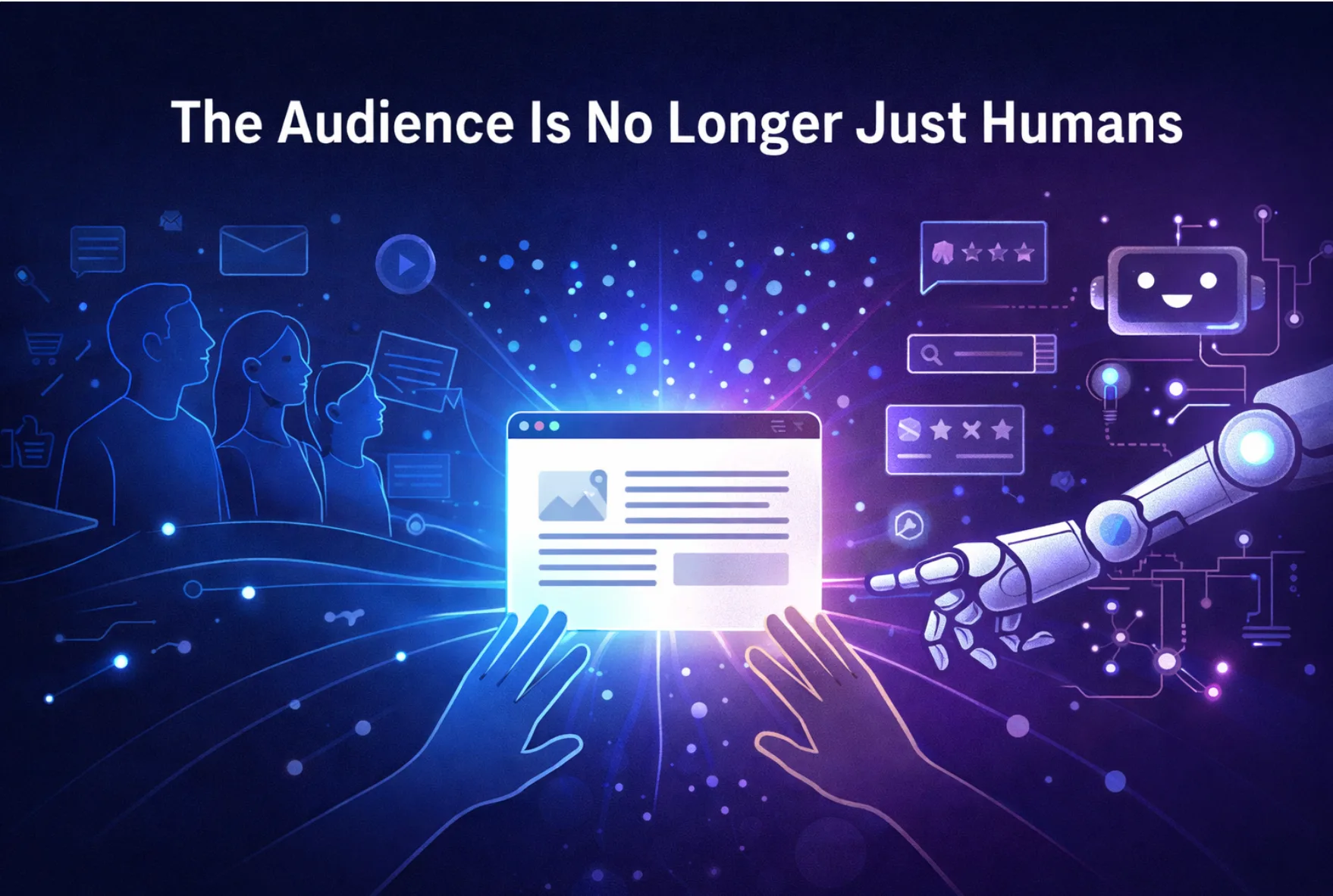
The Audience Is No Longer Just Humans
For most of modern marketing, we made one core assumption without even saying it out loud: the audience was a person.
Chris Parker · October 25, 2026 · 8 min read

The Future of MarTech & SaaS
Why Brand Will Outrank Performance
The most sustainable growth will come from being the brand people think of first, not the one they found in a sidebar ad. Buyers are craving trust and authenticity. Channels are crowded. Attribution is foggy. And the most underrated growth lever in B2B right now? Brand. Build it. Invest in it. Defend it. Because if people don’t believe in your brand your performance ads are just noise.
September 7, 2026 · 3 min read